



Text has become the cheapest thing on the internet to produce, which is why fluent prose no longer sets anyone apart. Google’s guidance reminds publishers that generative models predict likely word sequences rather than retrieve facts, and its latest revision, dated 1 October 2026, insists on manual fact-checking before publication.
So the useful question is not which tool writes fastest. It is which tools help a human produce work that is more accurate, more original and better edited than they could manage alone. This guide sorts ten widely used options by the job each does well, lists what they cost, and is blunt about what we could not verify.
Columnists need research support; marketing teams need brand consistency; SEO agencies need search intelligence; novelists need character continuity. Different work demands different software.
In its September 2026 comparison, Zapier noted that text generation is commonplace, making workflow, control and affordability more meaningful differentiators. This guide evaluates ten options using product documentation, pricing and independent coverage—not invented hands-on testing.
The best AI writing tools at a glance
For flexible brainstorming and drafting, ChatGPT is a practical starting point. Claude is worth considering for revising lengthy manuscripts; Gemini makes sense inside Google-centric workflows. Jasper targets coordinated brand marketing, while Anyword focuses on performance-oriented advertising copy. Writesonic and Surfer are specialised choices for content teams concerned with search workflows. Grammarly is the strongest as an editing layer, Sudowrite addresses fiction, and Rytr provides a relatively inexpensive entry point.
Start with what you write, where you publish and how much checking you can do.
How we evaluated these tools
This is a research-based editorial comparison, not a claim that all ten paid products were independently tested under controlled conditions. We reviewed official feature and pricing information alongside published assessments from Search Engine Land, Forbes Vetted, G2 and HubSpot.
Our framework weighs writing usefulness (25%), research reliability (20%), editorial control (15%), SEO/publishing features (15%), usability (10%), price (10%) and privacy (5%). These are not numerical test scores. Buyers should trial products on their own material.
AI writing tools compared: price, advantage and limitation
| Tool | Best for | Standout advantage | Advertised entry price* | Main trade-off |
|---|---|---|---|---|
| ChatGPT | Versatile writing projects | Interactive drafting and revision | Free; plus $20/month | Requires careful verification |
| Claude | Long-form revision | Working through complex source material | Free; Pro $20/month | Usage limits apply |
| Gemini | Google-based workflows | Integration with Google apps | Free access; AI Pro $19.99/month (US) | Benefits vary by product and region |
| Jasper | Brand marketing teams | Brand voice and campaign workflows | Pro $69/month | Higher cost than basic chat assistants |
| Writesonic | Search-content operations | AI articles plus visibility audits | Starter: $79/month, billed annually | Search platforms may be excessive for writers. |
| Grammarly | Polishing existing drafts | Clarity, tone and language editing | Free; Pro $12/month equivalent annually | Less focused on original reporting |
| Surfer | On-page content optimisation | Search-informed content editor | Discovery: $49/month, billed annually | Optimisation cannot guarantee rankings |
| Sudowrite | Novelists and storytellers | Fiction-specific story assistance | Hobby $10/month, billed annually | Not designed for factual journalism |
| Anyword | Ads and conversion copy | Predictive performance features | Starter: $49/month | Predictions are not actual campaign results. |
| Rytr | Budget short-form drafting | Simple writing use cases | Free; Lite $9/month | Less specialised editorial depth |
The advertised starting prices above follow the billing conditions stated; monthly-billed rates may be higher. Verify features, quotas and local checkout prices before subscribing.
The 10 best AI writing tools in 2026
1. ChatGPT — Best for versatile editorial workflows

ChatGPT’s advantage is breadth. It can turn reporting notes into outlines, challenge a headline, suggest interview questions, reorganise an argument and help revise a draft through multiple rounds. It works best as a collaborator, not an automatic replacement for editorial judgement.
Give it a source brief and target audience; request an outline and unresolved reporting questions before asking for prose.
Limitation: Fluent prose can conceal factual mistakes or fabricated citations. A browsing or research feature does not eliminate verification. OpenAI lists ChatGPT Plus at $20 monthly, with a free option and usage limits. Choose it if your work spans reporting, editing, marketing and analysis; skip it if you need a specialised optimisation platform with ready-made SEO workflows.
2. Claude — Best for refining long-form arguments

Claude is a compelling option when the hardest part of writing is preserving a coherent argument across a lengthy document. Its document-orientated workflow suits restructuring essays, comparing successive drafts, and identifying inconsistencies between sections. HubSpot’s 2026 overview also identifies long-form refinement and structured content as natural use cases.
Ask Claude to flag weak arguments, missing evidence and repetition before accepting its edits.
Limitation: A polished explanation is not proof that underlying citations are correct, and large projects remain subject to plan restrictions. Claude Pro is $20 per month in the US, or $200 annually. Choose it for manuscripts and complex revisions; consider ChatGPT if you want one assistant for a wider assortment of creative and analytical work.
3. Google Gemini — Best for Google Workspace users
Gemini’s appeal is not simply another text-generation interface. It lets you draft and revise within familiar Google products. A team already organising notes in Drive and working in Docs or Gmail may value fewer transfers between applications more than another collection of writing templates.
For newsletters, Gemini-assisted drafts can fit into an existing Google Docs editing process, provided a human checks every important claim.
Limitation: Features differ across products, countries and account types; some paid capabilities are unnecessary for a writer who rarely uses Workspace. The Google AI plans page lists a US Google AI Pro monthly price of $19.99 and describes integration with Gmail, Docs and Sheets. Choose Gemini if Google apps are central to your day; compare general assistants first if you mostly work outside that ecosystem.
4. Jasper — Best for coordinated brand marketing

Jasper is aimed at a problem that individual chatbot prompts often handle poorly: keeping numerous pieces of marketing content consistent with one brand. Teams can use brand guidance, campaign-oriented workflows and collaboration features to produce emails, landing pages and supporting social copy under a common editorial direction.
For a product launch, Jasper can help adapt approved messaging to three audiences while retaining brand guidelines.
Limitation: A brand-aware tool cannot establish whether a marketing claim is true or legally safe. It also costs considerably more than a general-purpose assistant. Jasper’s official pricing lists Pro at $69 monthly, or $59 monthly when billed annually; business pricing is customised. Choose it when consistent campaigns justify the subscription; independent writers should assess whether a cheaper assistant plus a style guide is sufficient.
5. Writesonic — Best for combined SEO and AI-search workflows

Writesonic has evolved beyond an uncomplicated article generator. Its current product combines AI-written articles, site audits and visibility monitoring across AI-powered search environments. That makes it more relevant to marketing operations assessing both conventional search and brand appearance in AI responses.
Teams can combine article planning with audits but must still verify sources and add original expertise.
Limitation: Monitoring features are not proof that a particular page will rank or be cited, and the platform’s broader scope increases cost. The official Writesonic pricing page lists Starter at $79 per month billed annually, including a stated allowance of 15 AI articles monthly. Choose it if search reporting and content production belong in one workflow; simpler teams may not need the overhead.
6. Grammarly — Best for editing before publication
Grammarly is most useful when there is already something worth saying. It helps identify awkward sentences, mechanical errors and tonal inconsistencies while keeping writers close to the original draft. This is valuable for busy editors who must polish submissions without changing their authors’ conclusions.
For guest columns, accept changes only when they preserve the author’s meaning and essential qualifications.
Limitation: Editing software cannot substitute for reporting, expert review or a factual check. Grammarly’s support documentation lists Pro at $30 monthly, or $144 annually—equivalent to $12 a month; a free plan is available. Choose it to improve existing copy; select a general drafting assistant if starting from a blank page is your chief problem.
7. Surfer — Best for search-informed content optimisation

Surfer focuses on the relationship between a draft and the search results it hopes to serve. Its content editor, optimisation guidance and related workflow features can help a publisher identify topics left unexplained, structural weaknesses and opportunities to make an article more complete.
Treat content scores as diagnostics, not orders to add every suggested keyword.
Limitation: Search-informed suggestions can reflect the weaknesses and sameness of existing results. The current Surfer pricing page shows a Discovery plan at $49 per month billed annually, with a broader Standard tier at $99 per month billed annually. Choose it when you already have credible editorial content and need an optimisation workflow; it is not a replacement for subject expertise.
8. Sudowrite — Best for fiction writers
Sudowrite is the clearest specialist on this list. Instead of centring its workflow on ranking pages or generating sales copy, it provides creative assistance for characters, scenes, descriptions and narrative continuity. Its fiction-oriented features are better matched to a novelist’s problems than generic business-writing templates.
Use it to explore alternative scene directions without surrendering control of the story.
Limitation: Its strengths do not transfer neatly to evidence-driven news or academic reporting. Credit allowances and model usage also require attention. Sudowrite’s plan documentation lists Hobby & Student at $10 monthly billed annually, or $19 with monthly billing. Choose it for imaginative writing; avoid paying for fiction-specific tools if you publish primarily reported articles.
9. Anyword — Best for performance-oriented marketing copy
Anyword approaches writing through an advertiser’s lens. Alongside copy generation, it offers prediction-oriented features designed to help marketers compare possible messages. For teams producing multiple ad headlines or campaign variations, that emphasis provides a more explicit decision framework than simply asking a chatbot for ten alternatives.
Anyword can produce audience-specific ad variants, but predictions must be tested against actual campaign results.
Limitation: It is narrower than a general editorial platform, and predictive signals should not be mistaken for guaranteed outcomes. Anyword lists Starter at $49 per month, or $39 monthly when billed annually, with a trial. Choose it if your success is measured through campaigns; a columnist or newsroom can probably spend that budget more effectively elsewhere.
10. Rytr — Best for inexpensive short-form assistance
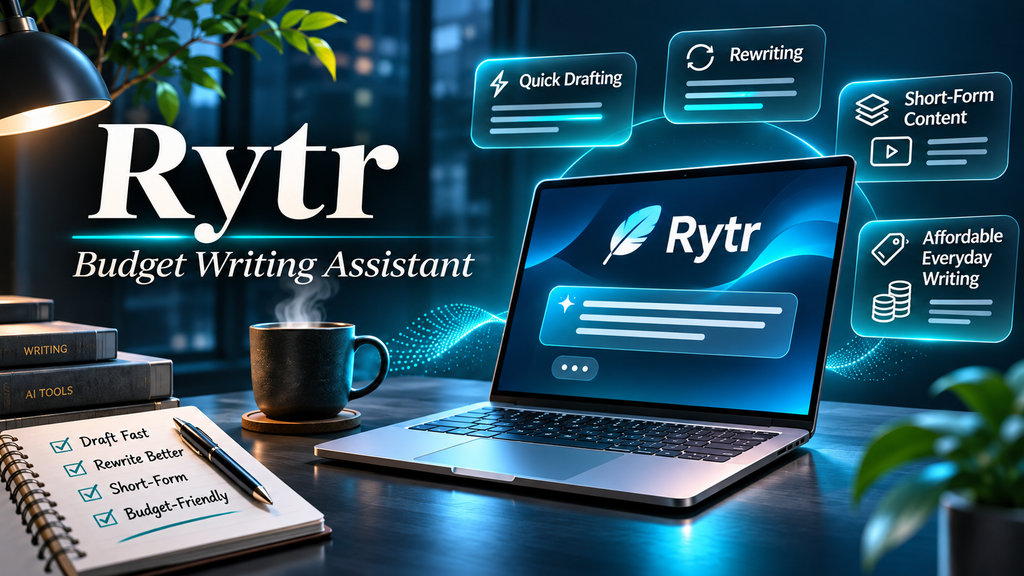
Rytr makes sense for writers who need frequent help with routine text but cannot justify a substantial monthly subscription. Its writing-oriented functions cover drafting and rewriting, with numerous use cases and languages. The product also incorporates broader relationship and communication features, so it should not be mistaken for a dedicated investigative-writing platform.
Start with emails, descriptions and social captions; do not expect specialist research support.
Limitation: Writers with complex sourcing, long manuscripts or demanding SEO projects may outgrow it. Rytr’s pricing page lists a free tier with 10,000 characters monthly and a Lite plan at $9 per month. Choose it to experiment on a budget; upgrade only after identifying a recurring task that a more specialised tool genuinely improves.
Which AI writing tool should you choose?
For a freelance blogger or opinion writer, begin with ChatGPT or Claude and invest time in a better source-gathering and editing process before buying another subscription. For a newsroom, pair a general assistant with human source verification and Grammarly-style copy editing; never let software invent attributed reporting. For a marketing department, Jasper offers workflow-oriented brand control, while Anyword is more closely tied to ad-copy experimentation.
An SEO agency should compare the total cost of Writesonic and Surfer against the work it actually performs: drafting, site audits, optimising existing pages and measuring search visibility are not interchangeable functions. Creative authors have a clearer specialist in Sudowrite. Newcomers on a tight budget can test free versions of general assistants, Grammarly or Rytr, before making a long-term purchase.
Test two shortlisted products on one real assignment. Compare editing time, errors and total cost.
How to turn AI drafts into premium, search-ready content
Start with a reporting question, not a keyword quota. Instead of Write about AI tools, try: Compare assistants for independent publishers; distinguish verified features, annual pricing and editorial risks. A precise brief gives the writer a stronger decision framework.
Gather sources, flag unsupported claims, outline around reader decisions, verify product details and add firsthand evidence: interviews, genuine tests or concrete examples.
Finally, edit for voice and verify links. Google’s people-first guidance asks whether content provides original insight and a satisfying answer. Its generative-AI guidance similarly warns against scaled output that adds no value. Those principles are more durable than claims that a special prompt can force a first-page ranking.
The hidden limitations of AI writing tools
The first risk is confident inaccuracy. A generated statistic, quotation or citation may look plausible even when it is wrong. Verify claims against sources you can inspect, and do not mistake a tool’s explanation of its reasoning for evidence.
The second risk is editorial sameness. If competitors feed similar prompts into similar systems, the result may be articles with interchangeable structures and insights. Search optimisation can compound the problem when everyone copies the same headings. Independent reporting, original examples and informed disagreement create differentiation.
Privacy and ownership also matter: do not upload sensitive source or client materials without checking policies and controls. Calculate the real cost of subscriptions, credits and human verification.
Frequently Asked Questions
What is the best AI writing tool in 2026?
There is no single best choice. ChatGPT suits flexible drafting, Claude is worth comparing for long-form revisions, Jasper targets brand marketing, Grammarly helps with editing, and Sudowrite specialises in fiction. Choose around your specific writing job.
Can AI writing tools create SEO-friendly articles?
Yes, they can assist with outlines, readability and content planning. They cannot guarantee rankings or substitute for useful expertise. Google’s AI-search optimisation guidance emphasises original, valuable content and established technical fundamentals rather than gimmicks.
Which AI writing tools are free?
ChatGPT, Claude, Gemini, Grammarly and Rytr provide some form of free access, although functionality and limits vary. Trial access is not the same as a permanently free subscription, and important paid features may be unavailable.
Is Claude or Jasper better than ChatGPT for writing?
It depends on the task. Claude deserves consideration for document-heavy revision; Jasper for organised campaigns and brand consistency; ChatGPT for flexible writing and research workflows. Compare the same real brief rather than relying on a universal ranking.
Can AI-generated articles rank in Google?
AI assistance does not automatically disqualify a page from Search. But content created primarily to manipulate rankings, especially at scale without added value, can breach Google’s spam policies. Accuracy, originality, usefulness and crawlable pages still matter. Indexing itself is not guaranteed.
Final verdict: better writing, not just more writing
The smartest purchase is rarely the product that can produce the most paragraphs. It is the one that removes friction from your particular process while leaving responsibility for evidence, judgment and voice where it belongs: with the author. Use AI to open up possibilities, challenge assumptions and sharpen the final draft. Let the finished work stand on what it teaches readers—not the speed with which it was generated.
Discover more from Whiril Media Inc
Subscribe to get the latest posts sent to your email.


Leave a comment